Showing posts with label Egypt Air flight MS-804.. Show all posts

Wednesday, June 1, 2016

EgyptAir Flight 804: 'Black box' signals detected,


EgyptAir Flight 804: 'Black box' signals detected, French investigators say

Cairo (CNN)A French naval vessel has detected underwater signals from one of EgyptAir Flight 804's so-called black boxes, investigators said Wednesday.

Specialized locator equipment on board the French vessel La Place detected signals from the seabed in the Mediterranean Sea, the Egyptian investigative committee said in a statement.
The director of the BEA, France's air accident investigation agency, later said it had confirmed the signals were from one of the recorders on the plane.
"The signal of a beacon from a flight recorder could be detected. ... The detection of this signal is a first step," BEA Director Remy Jouty said in a statement, according to an agency spokesman.
The Airbus A320, which had 66 people aboard, crashed in the Mediterranean on May 19 on a flight from Paris to Cairo.
Since then, authorities have been searching for wreckage and the plane's flight data and cockpit voice recorders, which could reveal evidence about what caused the crash.
Authorities hope to locate the data recorders, so a specialized vessel managed by the Deep Ocean Search company can then retrieve them. That vessel is set to join the search team within a week, the investigative committee said.
So far, search teams have found small pieces of debris, victims' remains and personal effects from the plane. They haven't found the aircraft's fuselage.
Analyst: Searchers are nearing wreckage
Detecting the beacon is a sign that searchers are closing in, CNN aviation analyst Mary Schiavo said.
"That means they're probably within one to three miles (of the black boxes)," she said. "That is the distance that these beacons can broadcast, so they are literally almost on top of them."
And it's likely, Schiavo said, that the recorders will be with the bulk of the wreckage from the plane.
"Hopefully they have finally got the right beacon, the right location, and soon we'll have answers," she said.
Conflicting reports over final moments
This isn't the first time investigators have said they detected a signal from the plane.
Last week a lead investigator in the search said airplane manufacturer Airbus had detected signals from the plane's Emergency Locator Transmitter, a device that can manually or automatically activate at impact and will usually send a distress signal.
Time critical
The signals gave investigators a more specific location to detect pings from the black boxes, state media reported.
Time is of the essence: The batteries powering the flight recorders' locator beacons are certified to emit high-pitched signals for about 30 days after they get wet.
Once they're found, the black boxes will be brought to Egypt, a civil aviation ministry official told CNN. That's standard procedure, the official said, similar to what happened in November with the recorders from Metrojet Flight 9268, which crashed in Egypt's Sinai Peninsula.
The data recorders have been fixtures on commercial flights around the world for decades.
The flight data recorder gathers 25 hours of technical data from the airplane's sensors, recording several thousand distinct pieces of information. Among the details investigators could uncover: information about the plane's air speed, altitude, engine performance and wing positions.
The cockpit voice recorder captures sounds on the flight deck that can include conversations between pilots, warning alarms from the aircraft and background noise. By listening to the ambient sounds in a cockpit before a crash, experts can determine if a stall took place and the speed at which the plane was traveling.
But black boxes aren't perfect. In several cases -- such as the 1996 crash of TWA Flight 800 or the crash of American Airlines Flight 77 on September 11, 2001 -- authorities had hoped to find clues in the recorders, only to discover that the data inside had been damaged or the recordings had stopped suddenly.

source: www.cnn.com

Saturday, May 21, 2016

Egyptian military says its has found debris from EgyptAir flight MS804


EgyptAir MS804 crash still a mystery after body part and seats found.

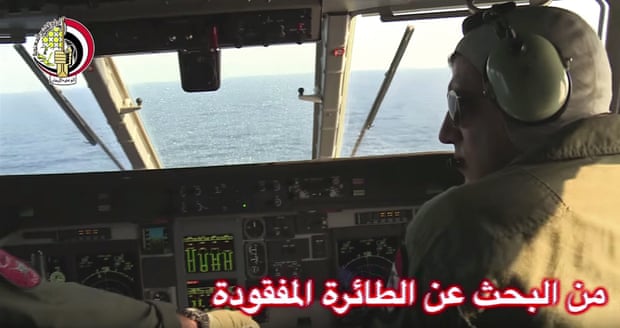
Egyptian plane searching the Mediterranean.
An image released by the Egyptian defence ministry from an Egyptian plane searching the Mediterranean. Photograph: Uncredited/AP


Greek defence minister says debris also including suitcases discovered, but definitive explanation could be weeks away.

Debris from the missing EgyptAir plane including a “body part”, two seats and suitcases were found floating in the Mediterranean on Friday. But investigators appeared no closer to explaining why flight MS804 suddenly plunged into the sea killing all 66 on board during a routine flight between Paris and Cairo.

Egyptian naval vessels found the wreckage 180 miles (295km) north of the coastal city of Alexandria. A European satellite saw an ominous mile-long oil slick about 25 miles south of the aircraft’s last known position.

“A short while ago we were briefed by the Egyptian authorities ... on the discovery of a body part, a seat and baggage just south of where the aircraft signal was lost,” the Greek defence minister, Panos Kammenos, told reporters in Athens.

The plane had taken a normal course through Greek airspace before abruptly taking sharp turns, he said, adding that the cause of the crash was still a matter of speculation. The plane crashed at around 2.30am local time on Thursday while carrying 56 passengers and 10 crew from Paris to Cairo, including Briton Richard Osman. All those on board died.
According to reports on Friday night, flight data suggested there were smoke alerts aboard MS804 minutes before it crashed.

Smoke was detected in the toilet and the aircraft’s electrics, according to data from the Aircraft Communications Addressing and Reporting System (Acars). Acars routinely downloads flight data to the airline operating the aircraft. The warnings came at about 2.26am on Thursday local time, just before air traffic controllers lost contact with the plane, the AFP news agency reported.

Despite theories that a bomb may have been smuggled on board, no claim of responsibility has so far been made by Islamic State or other terrorist groups. Typically, Isis claims responsibility for its attacks soon afterwards on Twitter and video.

Egypt’s military said it had found personal belongings and parts of the wreckage floating in the sea. It did not post photographs. The spokesman for the armed forces wrote on Facebook that the search was continuing.

Greek authorities said they had received information that the wreckage was discovered 10 miles “from the last known point” of flight MS804.
Greece’s lead air accident investigator, Athanasios Binis, said the “point of reference” was an area 130 miles south of the Greek island of Karpathos. The location is now the centre of a major international air and sea operation to find the plane’s black boxes.

“The most important thing is that the plane’s two black boxes are found,” Binis said. “If the cockpit flight recorder and flight data recorder are found, along with wreckage, then a real investigation can begin.

“There are three reasons for a plane [to go down],” he said. “Meteorological, technical and human. The first has now been ruled out because the weather was quite good. Whether a technical factor or human factor, either inside or outside the plane, is to blame remains to be seen. All possibilities are open.”
It now seems increasingly likely that it will take weeks, if not months, before a definitive account of MS804’s last moments can be pieced together. Egypt has been leading the search effort, with support from France, Greece, Turkey and the UK. The US navy dispatched a P-3 Orion maritime surveillance aircraft from a base in Sicily.

But Egypt’s previous record suggests a capacity for obfuscation, and even cover-up. It took nearly four weeks before the Egyptian president, Abdel Fatah al-Sisi, admitted that a Russian passenger jet which crashed last October on the Sinai peninsula had been blown up – a conclusion which Russia, the US and UK reached within a few days.

In 1999 Egypt also refused to accept that one of its pilots had deliberately flown his Boeing 767 into the Atlantic, killing all on board. Instead it insisted the crash was due to mechanical failure.

EgyptAir said on Thursday that it had found part of the wreckage and lifejackets from MS804 near Karpathos, east of Crete. The report turned out to be erroneous and the airline’s vice-president, Ahmed Adel, later retracted the statement.

The plane, built in 2003, made “sudden swerves” before dropping off the radar, Kammenos said on Thursday. It made a 90-degree turn left, and then dropped from 11,000 metres to 5,000 metres before swerving 360 degrees right, he said. Contact was lost at 3,000 metres, he said.
The plane’s captain, Mohamed Said Shoukair had clocked up 6,275 flying hours. He did not send a distress signal. There was no hint from his Facebook page of any Islamist proclivities. His posts included criticism of the Muslim Brotherhood, articles supportive of President Sisi, and photographs showing him wearing aviator sunglasses.

Khaled al-Gameel, head of crew at EgyptAir, said Shoukair had 15 years’ experience and was in charge of training and mentoring younger pilots. “He comes from a pilot family; his uncle was a high-ranking pilot at EgyptAir and his cousin is also a pilot,” Gameel said. “He was very popular and was known for taking it upon himself to settle disputes any two colleagues were having.”

Egypt’s aviation minister has said the Airbus A320’s sudden disappearance was more likely to have been caused by a terrorist attack than technical failure. But the French foreign minister, Jean-Marc Ayrault, said on Friday that there was “absolutely no indication” of why the flight came down.
Mike Vivian, former head of operations at the UK’s Civil Aviation Authority, told the BBC he thought the plane’s sudden swerves before dropping off radar were more likely to be caused by human interference than by a bomb.

“It looks highly unlikely that this was consistent with some sort of explosive device,” he said. “One’s inclined to go towards the theory that there had been some interference in the aircraft and on the flight deck, with the control of the aircraft.”
Officials from multiple US agencies told Reuters that a preliminary examination of satellite imagery had not shown any signs of an explosion. The anonymous sources said the US had not ruled out any potential causes for the crash, including mechanical failure, terrorism or a deliberate act by the pilot or crew.

Source: www.theguardian.com

EgyptAir flight MS804 smoke detected before crash


EgyptAir flight MS804: smoke detected in 'multiple locations' before crash.

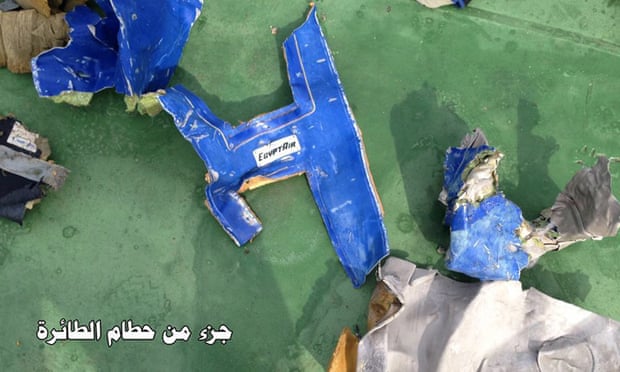
A picture of wreckage from EgyptAir flight MS804.
A picture posted on the Facebook page of the Egyptian armed forces spokesman shows part of the wreckage from EgyptAir flight MS804. Photograph: AP


French investigators confirm alerts sent in last minutes of flight indicated smoke in cabin, as Egyptian military releases pictures of debris
Smoke was detected in multiple places on board the missing EgyptAir flight MS804 minutes before it crashed, French investigators have confirmed, as the Egyptian military released pictures of the plane’s debris. Signs of smoke were picked up in a toilet and in the aircraft’s electronics, according to data from the Aircraft Communications Addressing and Reporting System (Acars), which routinely transmits data to airlines about the condition of their planes. As the search for the plane’s flight recorders continued, the Egyptian military released pictures of some the debris recovered on Friday. Photographs of a life vest, parts of the plane’s chairs and other wreckage were posted on Facebook. In France, investigators confirmed the data about smoke warnings that was first reported by the website Aviation Herald, while the French foreign minister Jean-Marc Ayrault said no theory on the cause of the crash has been ruled out. “At this time ... all theories are being examined and none is favoured,” he said after meeting with relatives of victims.
The warnings came at about 2.26am local time on Thursday, just before air traffic controllers lost contact with the plane, which plunged into the Mediterranean killing all 66 on board during a scheduled flight from Paris to Cairo.
David Learmount, a consulting editor at Flight Global, said the data presented the beginning of a sequence of events that could be “the answer to what happened”, but he could not confirm whether the fire was triggered by an act of terrorism or an electrical fault. “There’s a report of smoke in the forward lavatory [and] a minute later there’s smoke in the avionics bay, which is very worrying; and then two minutes later the flight control computers, one after the other, start to fail,” Learmount told BBC Radio 4’s Today programme. “Now the question we are left with is did this start with an ordinary electrical fault, a short circuit which started a fire, or was the fire started deliberately with a small explosion or an incendiary device? “It could still be terrorism but it looks as if the aircraft went out of control because the controls were literally burning up. But we don’t know if it’s terrorism that started this or an electrical fault.”
Shaker Kelada, the former head of Egypt’s plane crash investigations unit, cautioned against reading too much into the data. “Alone, it means nothing. It’s the last four seconds at the end of the transmission. If it’s an indication of anything it could be a followup to an explosion. It could also happen if someone smokes in the cockpit or the bathroom. But there was no warning in the cockpit. “This could be the first indication of a bomb. Or it can be unrelated. Since we don’t have any further information we cannot tell anything.” Greece’s lead air accident investigator Athanasios Binis said on Saturday that the search had been narrowed to a 900-square mile area, approximately 290km north of Alexandria. “That is where we are focusing and the sea there is between 7,500-10,000ft deep. Our priority, now, is to find the black boxes and as much wreckage as possible.” Investigators were still unclear whether the plane’s sudden drop in altitude was controlled or not, he added. “We still don’t know how it dropped from 37,000ft to 15,000ft or whether the pilot had tried to control it. It seems that they had a series of technical malfunctions before they lost control but what caused that we have yet to discover.”
The passengers included 30 Egyptians, 15 French citizens, two Iraqis, two Canadians, and citizens from Algeria, Belgium, Britain, Chad, Portugal, Saudi Arabia and Sudan. They included a boy and two babies. Seven crew members and three security personnel were also on board.
Ayrault, who was joined by Egypt’s ambassador to France at the meeting with passengers’ relatives on Saturday, said: “I strongly emphasised the desire of the French authorities to tell the entire truth about what happened. It’s a legitimate and essential expectation for all the families.” The meeting took place “in a climate of intense emotion and great dignity,” he said. Ayrault said finding the plane was a priority, along with finding black box recorders. A spokesman for France’s Bureau of Investigations and Analysis told AFP on Saturday: “There were Acars messages emitted by the plane indicating that there was smoke in the cabin shortly before data transmission broke off.”
The spokesman said it was “far too soon to interpret and understand the cause of Thursday’s accident as long as we have not found the wreckage or the flight data recorders”. The plane had taken a normal course through Greek airspace before abruptly taking sharp turns. The plane crashed at about 2.30am local time on Thursday while carrying 56 passengers, including Briton Richard Osman, and 10 crew. All those on board died. Despite theories that a bomb may have been smuggled on board, no claim of responsibility has so far been made by Islamic State or other terrorist groups.


source: www.theguardian.com

Thursday, May 19, 2016

Follow up, What we know so far about Egypt Air flight MS-804


Here’s what we know so far about EgyptAir flight MS804, which went missing en route from Paris to Cairo at 2.30am local time Thursday morning.


EgyptAir retracted its claim to have found wreckage belonging to MS804, falling in line with Greek authorities who said that floating debris did not belong to the plane. “We stand corrected,” Airline vice-president Ahmed Adel told CNN, adding that the recovered debris “is not our aircraft”.

President Abdel Fatah al-Sisi ordered the navy, air force and army to join with Egyptian, French, Greek and US forces searching the Mediterranean for debris. The debris falsely attributed to MS804 was found near the island of Karpathos, east of Crete.

Egypt’s aviation minister Sherif Fathy said terrorism was more likely than technical failure to be the cause of the crash. “The possibility of having a terror attack is higher than the possibility of having a technical [problem],” he told reporters. French president François Holland, Egyptian prime minister Sherif Ismail and the White House said that terrorism could not be ruled out.

No group has claimed responsibility for downing the aircraft, and search teams still have no sign of the Airbus A320 or the 66 people who were on board. The plane is presumed crashed in the Mediterranean, east of Greece and about 10 miles into Egyptian airspace. “Family members of passengers and crew have been already informed and we extend our deepest sympathies to those affected,” EgyptAir said in a statement.

The plane made “sudden swerves” before dropping off radar over the Mediterranean, Greek defense minister Panos Kammeno said. The plane made a 90-degree turn left, and then dropped from 37,000 feet to 15,000 feet before swerving 360 degrees right, he said.


The plane was carrying 56 passengers and 10 crew: two cockpit crew, five cabin crew and three security personnel. The airline said two babies and one child were on board. Among the passengers were 30 Egyptians, 15 French, two Iraqis, and one person each from the UK, Belgium, Kuwait, Saudi Arabia, Sudan, Chad, Portugal, Algeria and Canada.

The plane, on its fifth journey of the day, was traveling at 37,000 feet when it disappeared from radar. It had made a stop in Tunisia before flying to Paris. EgyptAir says the captain has 6,275 flying hours, including 2,101 on the A320; the copilot has 2,766. The plane was manufactured in 2003.


Source: www.theguardian.com